MVP: What It Is, Why Businesses Need It, and How to Launch a Minimum Viable Product
Imagine a team comes up with an idea for a service that automates appointment scheduling. They could spend months building a user dashboard, integrations, analytics, a mobile app, and dozens of additional features. But after launching, they might discover that users only needed a simple booking form and automatic confirmation.
An MVP (minimum viable product) helps test these assumptions earlier. Instead of building a complete product right away, the team releases a basic working version, puts it in the hands of real users, and observes whether it solves the intended problem.
The main purpose of an MVP in business is not just to reduce development costs but to gather actionable data faster. If the hypothesis is validated, the product can be developed further. If not, the team can adjust its approach before investing much more time and money.
The MVP principle applies beyond product development. In marketing, the same approach can be used to test demand, offers, target audiences, or acquisition channels before committing substantial resources.
The logic remains the same: run a limited experiment, collect real-world data, and only then scale your efforts.
Essentially, a marketing MVP answers the same question as a product MVP: what is the smallest thing we can do to gather real-world data before scaling?
What Is an MVP in Simple Terms?
The MVP concept became one of the central ideas behind the Lean Startup methodology. Eric Ries defines a minimum viable product as a version of a new product that allows a team to collect the maximum amount of validated learning about customers with the least effort.
That is why the primary goal of an MVP is not to release the first version as quickly as possible, but to gather data that helps guide the product’s future development.
Let’s break down the term.
Minimum. The product includes only the features necessary to test the core hypothesis. This does not mean doing as little as possible. If users cannot get value without a particular feature, that feature is essential rather than optional.
Viable. The product must genuinely solve at least one user problem. A calculator that produces incorrect results, a form that doesn’t work, or a practically unusable app does not qualify as an MVP simply because it has few features. Even a minimal version must deliver clear value.
Product. Users interact with an actual solution rather than just a concept for a future system. In some cases, a very simple implementation, a manually delivered service, or a single core feature is enough.
So, that’s why an MVP is more than just “the first version of an app.”
An MVP is a tool for validating hypotheses.
For example, imagine a team wants to build a service that automatically generates personalized meal plans. A fully developed product might include an app, a recipe database, recommendation algorithms, integrations with grocery stores, and analytics.
But the core hypothesis is much simpler: are people willing to use personalized meal plans regularly, and do they find the recommendations useful?
There is no need to automate the entire process for the initial test. Users could fill out a form, while a specialist manually prepares a meal plan and sends it by email. If users return, follow the recommendations, and are willing to pay, the team has evidence to support investing in automation.
This type of MVP is much simpler than the final product, yet it still provides the data needed to make informed decisions.
Why an MVP Is Not an Unfinished Product
The “minimum” in MVP refers to the scope of the solution, not the quality of its core functionality. An MVP must reliably deliver the value it was designed to provide.
If an MVP for a booking service allows users to select a date and submit a request, that process must work smoothly and predictably. Not having an advanced loyalty program is perfectly acceptable. However, losing a user’s booking request due to a technical error undermines the ability to validate the hypothesis.
That is why a better question to ask during development is not “What else can we remove?” but rather “What is the minimum experience that will deliver value to users and help us learn something meaningful?”
How an MVP Works
The approach is based on a short cycle:
Hypothesis → MVP → Real Users → Data → Insights → Next Iteration
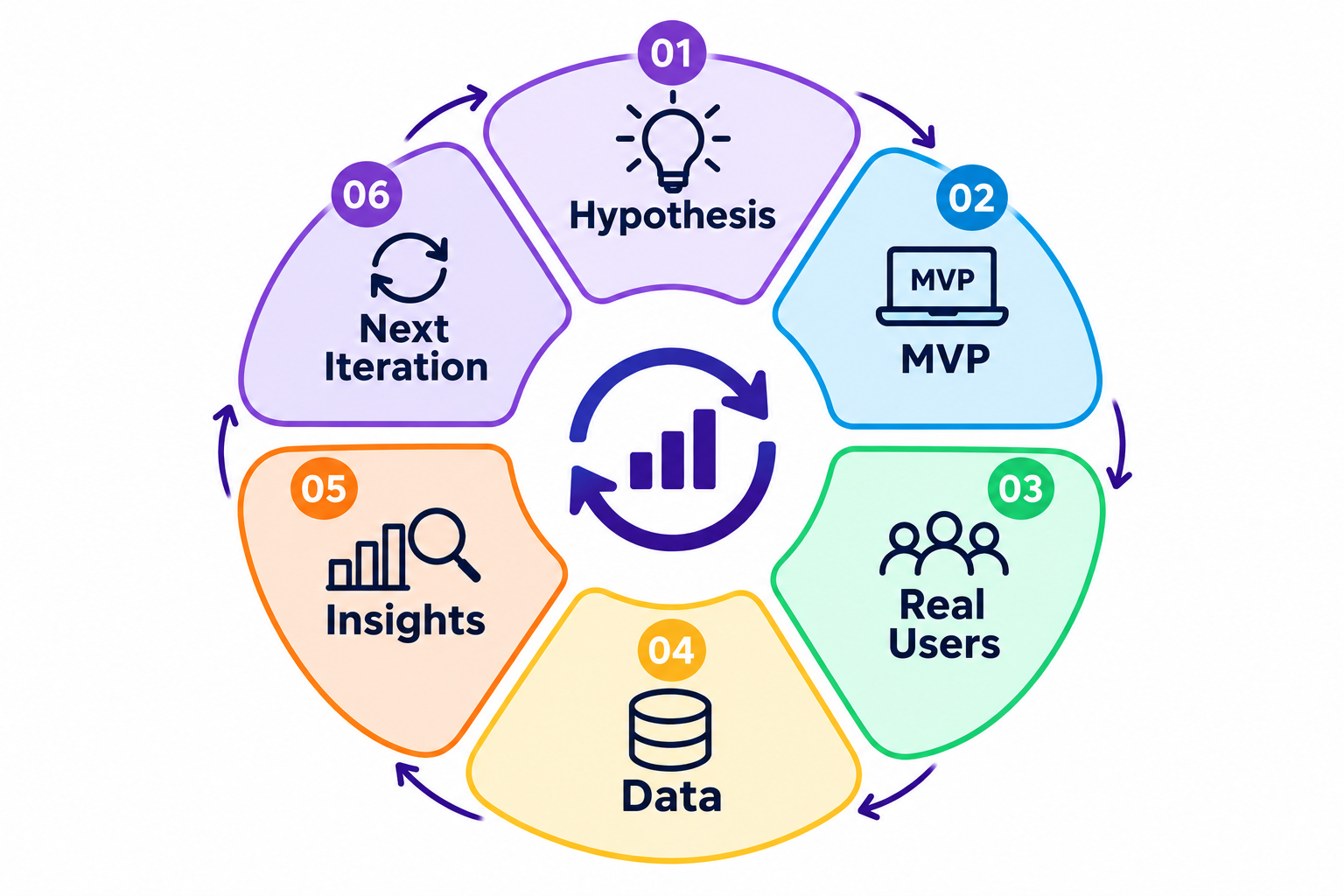
The team starts by formulating an assumption. For example:
“Small businesses are willing to pay for a service that automatically generates weekly sales reports.”
Next, the team identifies the simplest way to test this assumption. There is no need to build a complex analytics platform right away. Initially, the team can manually upload customer data, generate a report, and see whether users are willing to come back for it every week.
If the value is validated, manual processes can gradually be automated. This principle is central to the Lean Startup methodology: the purpose of an MVP is to replace the team’s internal assumptions with real user data as early as possible. Atlassian also describes a minimum viable product as a way to test an idea, gather feedback, and use those insights to make further product development decisions.
An MVP can help validate different hypotheses:
- Whether the problem actually exists and is important enough to solve;
- Whether users understand the value of the proposed solution;
- Whether they are willing to start using it;
- Whether they are willing to pay;
- Whether they return after their first experience;
- Whether the intended user journey works;
- Which version of the product users respond to more positively.
However, a single MVP rarely answers all these questions at once. The more precisely the hypothesis is defined, the easier it is to choose an appropriate testing method and interpret the results.
Why Businesses Need an MVP
MVPs are often associated with startups, but the approach is equally applicable to established companies. Large businesses also launch new products, enter new market segments, and test features when demand is still uncertain.
When people search for “startup MVP,” they usually mean the first version of a product that founders use to test key assumptions before scaling. However, the same principle applies to established businesses.
Validate Real Market Demand
Interviews and research help businesses understand audience expectations, but people’s behavior after a product launch may differ from what they say.
A user might say they like the idea of a new service but never sign up. They might register but never use any of its features. Or they might actively use the product but refuse to upgrade to a paid version.
An MVP allows businesses to move beyond asking “Do you like this idea?” and start observing actual user behavior.
Reduce the Cost of Failure
The most expensive mistake is not launching an initial product version that fails. A much bigger problem is spending months building a complex system only to discover that the core hypothesis was wrong.
An MVP reduces the size of the initial investment. If the idea is not validated, the business loses only the cost of a limited experiment rather than the entire development budget. If the hypothesis is confirmed, the team has a stronger case for further investment.
Gather Feedback Before Scaling
Even a strong product idea is rarely implemented perfectly on the first attempt.
After launch, the team may discover that users find the interface confusing, prefer a different workflow, use a feature in an unexpected way, or consider something important that the team initially viewed as a minor detail.
The earlier this information becomes available, the less expensive it is to make changes to the product.
Identify Real Product Priorities
Before launch, the feature list is typically based on research, team assumptions, management requests, and competitor analysis.
After launch, another source of information becomes available: actual user behavior. This helps distinguish features that seem important internally from those that genuinely contribute to the product’s value.
MVP vs. Prototype vs. PoC (Proof of Concept): What’s the Difference?
These concepts are often confused, although they answer different questions.
| Format | Main Question | Who Typically Tests It | Outcome |
|---|---|---|---|
| PoC | Is the idea technically feasible? | Internal team, developers, experts | Confirmation or rejection of technical feasibility |
| Prototype | How should the user experience look and work? | Internal team and test users | A mockup or interface model |
| MVP | Does the product solve a real user’s problem? | Real users or early customers | A functional minimum product and user behavior data |
PoC is primarily used to verify technical feasibility. For example, a team might want to determine whether a system can process a data stream at the required speed. A user interface may not even exist at this stage.
A prototype helps test the structure of a future product, including screen layouts, navigation flows, and interface usability. It may look realistic but does not necessarily need to perform every action.
An MVP must already give users a chance to experience the value it promises. That is why testing should involve people outside the development team. Atlassian also distinguishes between these formats: a PoC primarily tests technical feasibility, while an MVP helps validate the product idea and market demand with real users.
In practice, these stages do not always have to follow a strict sequence. If there are almost no technical risks, a separate PoC may be unnecessary. For a simple service, a team may move directly from user research to building a small MVP.
Types of MVP
An MVP does not necessarily have to look like a simplified mobile app. The format depends on the specific uncertainty the team needs to address.
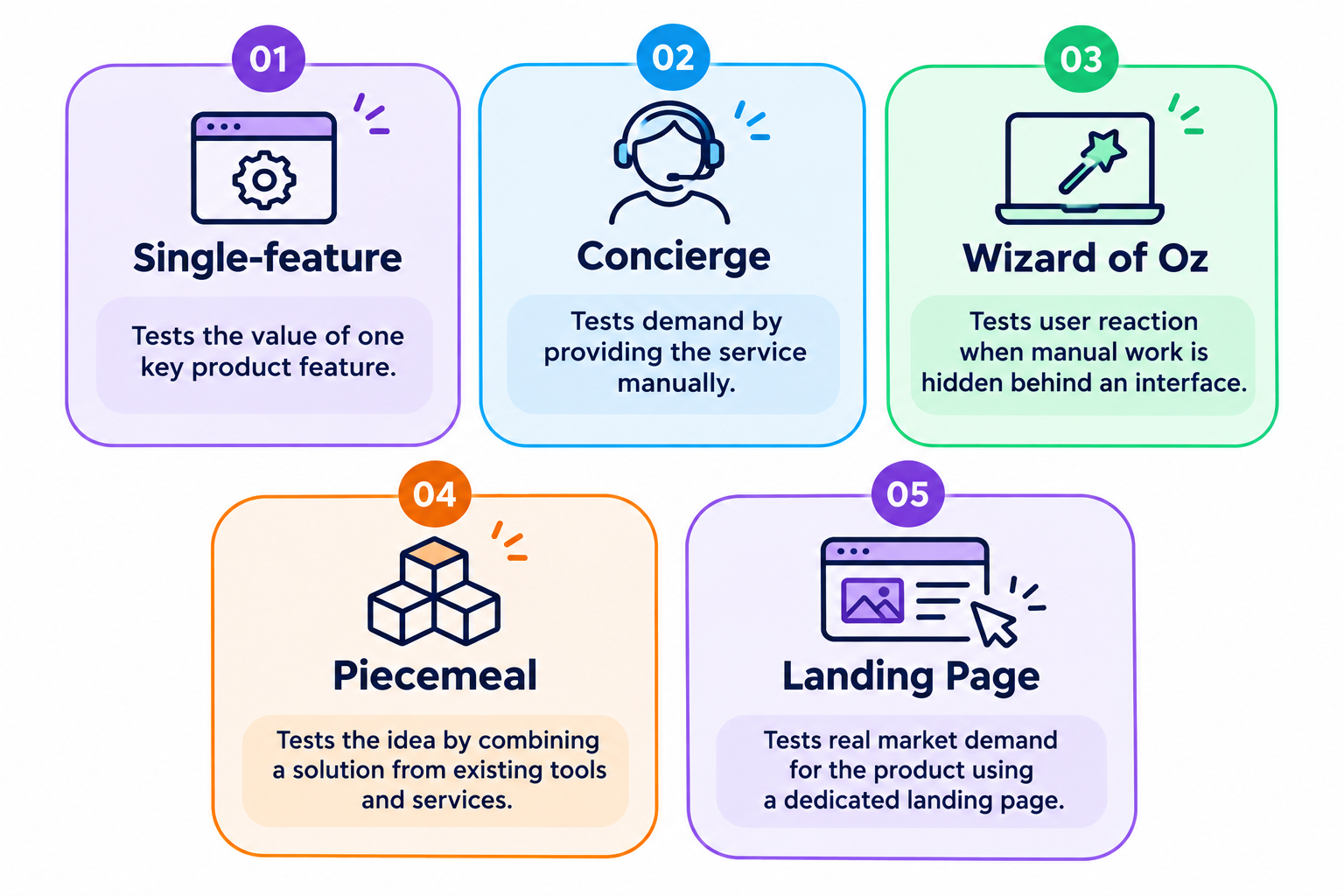
Single-Feature MVP — An MVP with One Core Feature
This type of product focuses on a single core feature that delivers its main value.
For example, a team plans to build a comprehensive project management platform but initially releases only a tool for collaboratively reviewing and approving tasks. If people use this feature regularly, the team has a reason to develop the platform further.
The main advantage of the single-feature approach is focus. It makes it easier for the team to understand what value users receive and why they keep coming back.
Concierge MVP — A Manually Delivered Service
In a Concierge MVP, the service is delivered manually. Users know they are interacting with a person, while the team tests the underlying value proposition of the future product.
Imagine a supplier-matching service. Instead of developing an algorithm, the team asks users to submit their requirements. A specialist then manually finds several suitable options and sends the results.
This approach helps the team determine whether customers need the service, which criteria matter most to them, and whether they are willing to pay for the results before automating the process.
Wizard of Oz MVP
With this type of MVP, users interact with an interface that appears to be a fully functioning automated system, while some of the operations behind it are performed manually.
For example, a customer enters their preferences into a recommendation service and gets a result a few minutes later. From the customer’s perspective, the process appears automated, even though the team is still handling the request manually.
Wizard of Oz and Concierge MVPs are similar, but they differ in how users experience the service. In a Concierge MVP, users know the service is being delivered manually, while in a Wizard of Oz MVP, the manual work happens behind the scenes.
Piecemeal MVP — An MVP Built from Existing Tools
Instead of developing its own infrastructure, the team combines several existing tools.
For example, a request is submitted through a form, the data is automatically transferred to a spreadsheet, an employee processes the request, and the result is delivered through a separate communication channel.
To users, this may appear to be a single service, even though it consists of several ready-made components. This approach works well when the main question is not whether the technology is unique, but whether users actually need the proposed solution.
Landing Page MVP
A landing page is designed to describe the future product and encourage visitors to take a specific action: join a waitlist, submit an inquiry, request a demo, or place a pre-order.
This experiment allows the team to assess interest in the offer before investing in full-scale development.
But interpreting the data correctly is essential. A button click or an email address added to a waitlist indicates interest, but it does not prove that someone will become a regular paying customer.
A Landing Page MVP is best viewed as a way to validate early demand rather than the entire business model.
Famous MVP Examples
Dropbox. Before the product’s full launch, the team used a demonstration video to show how file synchronization would work and gauge audience interest. According to Drew Houston, after the video was published, the beta waitlist grew from 5,000 to 75,000 people virtually overnight. This helped validate demand before investing in large-scale product development.
Zappos. Founder Nick Swinmurn initially avoided investing in his own shoe inventory. Instead, he posted photos of shoes from local stores on his website. When a customer placed an order, he purchased the shoes from the store and shipped them to the customer.
This allowed the team to test its central assumption: whether people were willing to buy shoes online in the first place.
Both examples illustrate the same principle: an MVP does not have to be a smaller version of the final product. Sometimes, the simplest way to validate a key assumption is to observe how real users behave.
| MVP Type | What It Tests | Typical Testing Period | Budget Compared to a Full Product |
|---|---|---|---|
| Landing Page MVP | Whether there is interest in the offer | A few days to 2 weeks | Low |
| Concierge MVP | Whether users need the service itself | 1–4 weeks | Low |
| Wizard of Oz MVP | Whether the user experience works | 1–4 weeks | Low to medium |
| Single-Feature MVP | Whether the core feature is needed | Several weeks or more | Medium |
| Piecemeal MVP | Whether a functional solution can be assembled from existing tools | A few days to several weeks | Low to medium |
The timelines and budgets shown here are estimates. They depend on the product, market, implementation complexity, and the hypothesis the team wants to test.
MVP in Marketing: What Can You Validate Before Making Major Investments?
In marketing, an MVP typically takes the form of a limited experiment focused on a single hypothesis rather than a standalone product.
For example, a business can test:
- Demand for a new product or business segment: research search queries, analyze search results, create a landing page, and drive a small amount of traffic to the page.
- New positioning: test several versions of a value proposition with the same target audience before changing messaging across the entire website.
- A new market: assess demand and customer acquisition costs before fully localizing the website and investing heavily in search engine optimization (SEO).
- A new marketing channel: launch a limited advertising campaign or publish several pieces of content, then compare actual leads with the initial hypothesis.
- A new service: start by collecting inquiries and handling part of the process manually, introducing automation only after demand has been validated.
This approach is particularly useful for startups. In the early stages, it is easy to spend months building a website, creating content, developing an SEO strategy, and setting up advertising infrastructure without first validating the most important assumptions: whether there is enough demand and whether the target audience understands the offer.
Search can be a useful tool for validating these assumptions. A team can analyze search volume and keyword patterns, study competitors in search results, create a basic landing page, and measure audience response through a small-scale advertising test.
Yevhen Sarhosh shares more insights into SEO experiments, hypothesis testing, case studies, and entering new markets on his Telegram channel, SEOETC.
How to Estimate Search Demand Before Launch
One tool for this type of research is Google Keyword Planner. It allows businesses to identify product-related search queries, view estimated monthly search volumes in a selected market, and assess potential advertising costs for those keywords.
These figures do not guarantee that a product will succeed. But they help estimate the scale of existing demand and determine whether it makes sense to move to the next testing stage, such as launching a landing page and a limited advertising campaign.
Yevhen Sarhosh discussed a practical example of this approach in this Telegram post.
However, a single experiment cannot prove the viability of an entire business model. Its purpose is narrower: to validate a specific hypothesis and determine whether further investment is justified.
The same approach can be applied before scaling marketing efforts in a new market. For example, a company can first assess search demand, analyze competitors in search results, and identify which pages and offers are already visible in search results.
At Phoenix Project, this preliminary assessment can be carried out as part of an SEO analysis. It helps assess a website’s current performance, competitors, and growth potential before a business commits a significant budget to localization and a comprehensive SEO strategy.
Insights from Phoenix Project’s Experience
A similar principle applies when businesses enter new markets: understanding the current situation should come before scaling investment.
A marketing MVP is especially valuable when the cost of making a mistake is high. Examples include entering a major international market such as the United States or the United Kingdom, launching a new service, or adding a new product category to an online store. In these situations, a small-scale test helps validate actual demand and the chosen approach before investing in full-scale marketing.
In one project, Phoenix Project worked with a B2B consulting company (business-to-business, meaning services provided to other businesses) targeting the US and UAE markets. During the initial stage, the team analyzed the website’s existing backlink profile and competitors to identify gaps in backlink quantity and quality and establish SEO priorities.
At the beginning of the project, the website received 97 organic visits and ranked for 294 keywords. After five months, organic traffic increased to 193 visits, while the number of ranking keywords grew to 464.
This was not a product MVP in the traditional sense, but the underlying principle was similar: first gather data about a specific market and evaluate the chosen approach using measurable performance indicators, then scale investment.
Another analysis of testing and scaling strategies is available on Yevhen’s Telegram channel.
Explore More Phoenix Project Case Studies
How to Build an MVP: Key Stages
Launching an MVP does not start with choosing the technology. If a team immediately starts discussing frameworks, design, and screen layouts without identifying the main uncertainty, an MVP can quickly turn into a full-scale development project.
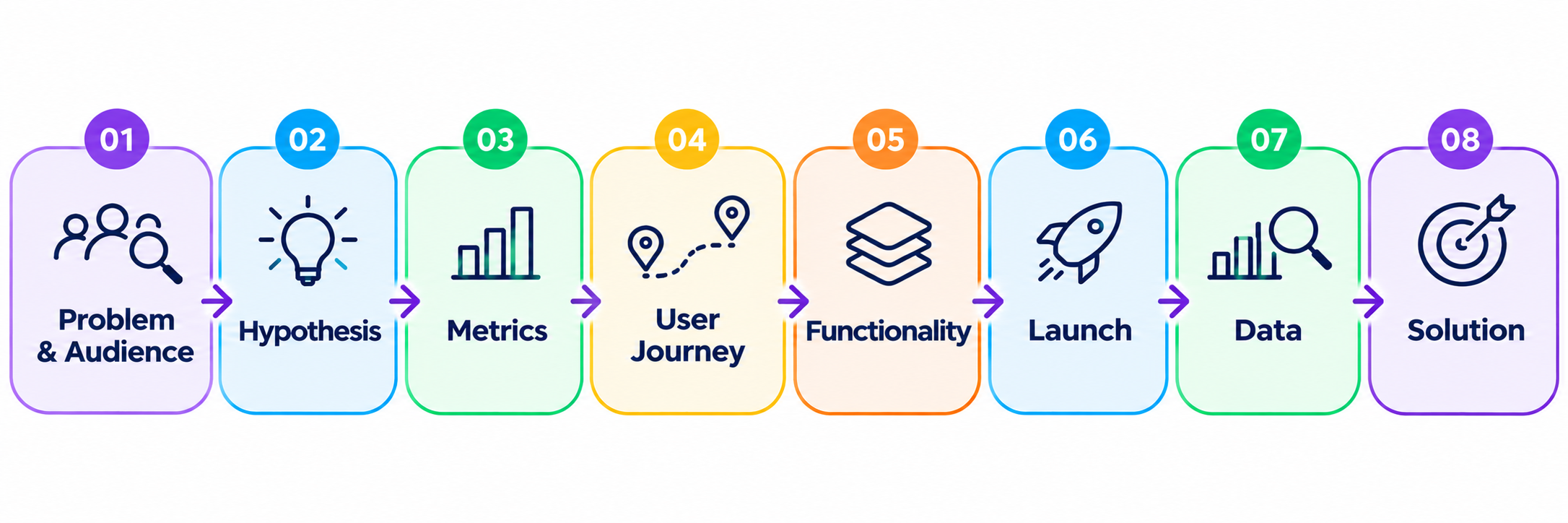
1. Identify the Problem and Target Audience
Start by understanding the users’ situation. Who experiences the problem? How do they currently solve it? How often does it occur? What frustrates them about existing solutions?
A statement like “We want to build a personal finance management app” is too broad. A more useful hypothesis would start with a specific problem:
“Freelancers struggle to estimate how much money they can spend after covering essential expenses, so they need a simple forecast of their available balance.”
This makes the target audience, the problem, and the potential value of the solution much clearer.
2. Formulate a Hypothesis
A good hypothesis must be testable. For example:
“If users can see a forecast of their available funds through the end of the month, they will return to the service at least once a week.”
Now the team knows exactly what user behavior to measure.
A statement like “Users will love our financial service” provides very little value. Even positive feedback does not indicate whether the product has become part of users’ actual routines.
3. Define Success Metrics
Success criteria should ideally be established before launch. Otherwise, after the experiment, it is easy to focus only on the metrics that look most favorable.
The metrics depend on the hypothesis. They might include the number of leads, repeat usage, completion of a key user journey, or actual payments. We will explore how to measure MVP performance in more detail below.
4. Map the User Journey
Describe the minimum sequence of actions a user must take to get value from the product, starting with their first interaction. Here is an example:
Sees the offer → Signs up → Enters data → Receives a calculation → Saves the result.
Every additional step should have a clear purpose. If the hypothesis can be tested without it, that step may not be necessary in the first version.
5. Choose the Minimum Essential Features
Keep only the features users need to receive the core value or that the team needs to validate the key hypothesis.
We will discuss feature prioritization methods in more detail below.
6. Build and Launch the MVP
The format depends on the objective. It could be a small functional service, a single feature, a manually delivered service, a landing page, or a combination of existing tools.
What matters most is that the chosen format actually tests the hypothesis.
An attractive landing page will not answer questions about long-term retention. An interface prototype will not demonstrate whether users are genuinely willing to pay. And a technical proof of concept (PoC) will not validate market demand.
7. Collect Data and Feedback
Quantitative data shows what users do. Qualitative data helps explain why they do it.
That is why it is useful to combine analytics with interviews, open-ended surveys, customer support inquiries, and observations of how people use the product.
For example, a low sign-up conversion rate might indicate weak demand. However, the problem could also be unclear messaging or an overly complicated registration form.
8. Decide on the Next Development Steps
After testing, the team should have a clear decision to make, not just a report to review. There are some possible outcomes to consider:
- The hypothesis is validated, and the product can be expanded.
- The product delivers value, but its implementation needs improvement.
- The wrong target audience was selected, so the test should be repeated with a different segment.
- Users are more interested in another feature, suggesting a change in direction.
- The original problem is not important enough to justify further investment, so the product should not be scaled.
Deciding to abandon a weak idea is also a valuable MVP outcome. The team has gathered evidence before making a major investment.
How to Decide Which Features Your MVP Needs
One of the hardest parts of building an MVP is knowing when to stop. As soon as the initial feature list takes shape, almost every feature starts to seem important. The team needs a framework that separates essential functionality from desirable additions.
One way to do this is the MoSCoW prioritization method. It divides features into four categories: Must Have, Should Have, Could Have, and Won’t Have for now.
Must Have – Without this feature, the team cannot validate the hypothesis or deliver the core value.
Should Have – The feature is important, but the experiment can still be conducted without it.
Could Have – A useful improvement that does not affect the core user journey.
Won’t Have for Now – A feature deliberately postponed until a later stage.
Imagine an MVP for an appointment booking service.
Must Have: Select a service, choose an available time slot, and submit a booking request.
Should Have: Receive an automatic reminder.
Could Have: Add a specialist to favorites.
Won’t Have for Now: A loyalty program, an advanced recommendation system, and personalized suggestions.
However, prioritization should not become a mechanical exercise in filling out a table. The hypothesis remains the primary decision-making criterion.
If a feature does not help validate the key assumption and users can still receive value without it, including it in the initial release requires additional justification.
How to Measure MVP Results
The success of an MVP should not be measured by the number of features released or whether the product launched on schedule. The real question is: what has the team learned about its users and how they interact with the product?
Metrics should be selected based on the hypothesis being tested.
To validate market demand:
- Leads and registrations;
- Percentage of visitors who complete the desired action;
- Pre-orders;
- Demo requests.
To validate the product’s initial value:
- Percentage of users who complete the core user journey;
- Time to value;
- User activation;
- Repeat usage of a feature.
To validate long-term value:
- Retention rate;
- Usage frequency;
- Churn rate;
- Number of users returning after a specified period.
To validate the business model:
- Conversion to paid customers;
- Average revenue per customer;
- Customer acquisition cost;
- Renewal or repeat purchase rate.
There is no need to track dozens of metrics. For an MVP, it is more useful to have one primary metric directly tied to the hypothesis, supported by a few secondary indicators that help interpret the results.
How to Know Whether a Hypothesis Has Been Validated
Success criteria should be defined in advance. For example:
“At least 30% of new users must complete the core user journey within their first day.”
In this case, a result of 34% could justify moving to the next stage, while 8% would require further investigation.
However, the number alone does not explain the reason behind the result. If users failed to complete the process because of a technical issue, the test does not necessarily indicate a lack of demand.
That is why MVP evaluation usually combines analytics with an analysis of user behavior.
Common Mistakes When Building an MVP
Including Too Many Features
The team tries to account for every possible use case from the start, and the MVP gradually turns into a full-fledged product. Development timelines grow, experiment costs increase, and the team still does not know whether users actually need the core idea.
Before adding each feature, it is useful to ask: which assumption does this feature help us validate?
Failing to Define a Specific Hypothesis
“Let’s launch it and see what happens” is not a research plan. If the team does not define in advance what changes in user behavior it expects to see, interpreting the results after launch will be difficult.
Targeting the Wrong Audience
Even a strong product can deliver disappointing results if it is tested with the wrong people.
If a service is designed for CFOs at large companies, testing it with random users will not provide meaningful insights into demand within the target segment.
Not Defining Success Metrics
Without clear success criteria, any number can be interpreted retrospectively. One hundred registrations might seem like an excellent result. But if 100,000 relevant visitors landed on the page, the picture looks very different.
Context always matters more than an isolated number.
Testing Too Many Unknowns at Once
Imagine a team simultaneously changes its target audience, pricing model, acquisition channel, and core feature. After launch, sales increase.
What exactly caused the improvement?
The more variables the team changes at the same time, the harder it becomes to draw meaningful conclusions. That is why initial experiments should focus on the riskiest assumption.
When an MVP Is Not Necessary
The MVP approach is not suitable for every situation. Sometimes, any initial release is automatically labeled an MVP, even when the underlying uncertainty could be addressed more effectively through another approach.
When Technical Feasibility Must Be Confirmed First
If the main risk is related to technology rather than demand, it makes more sense to start with a proof of concept (PoC).
For example, a team may not yet know whether an algorithm can process data with the required accuracy and speed. Involving users before answering this question may be premature.
When Minimizing Features Compromises Safety
For products involving healthcare, finance, transportation, critical infrastructure, or sensitive data processing, mandatory safeguards cannot be removed simply to speed up the launch.
Functionality can be minimal, but essential requirements for safety, privacy, and accuracy must still be met.
In such cases, MVP testing is often conducted in a restricted environment, with a controlled group of users, or after completing mandatory checks.
When the Product Already Exists and the Risks Are Well Understood
If a company is making a small change to a well-established user journey and already has sufficient user data, creating a separate MVP may be unnecessary.
Sometimes, an A/B test (which compares two variations) or a prototype can provide a clearer answer at a lower cost.
When a Minimal Version Cannot Deliver Standalone Value
Some products cannot be simplified without fundamentally changing the intended user experience. In such cases, the test results may no longer be representative.
The better approach is to find a different experiment format rather than trying to label the first release an MVP at all costs.
What to Do After Launching an MVP
It is just the beginning of the validation process, not the end of development.
After collecting the initial data, the team revisits the original hypothesis:
- What did we expect to see?
- What actually happened?
- Where did the results differ from our expectations?
- Why are users behaving this way?
- Which assumption is now the most important to test?
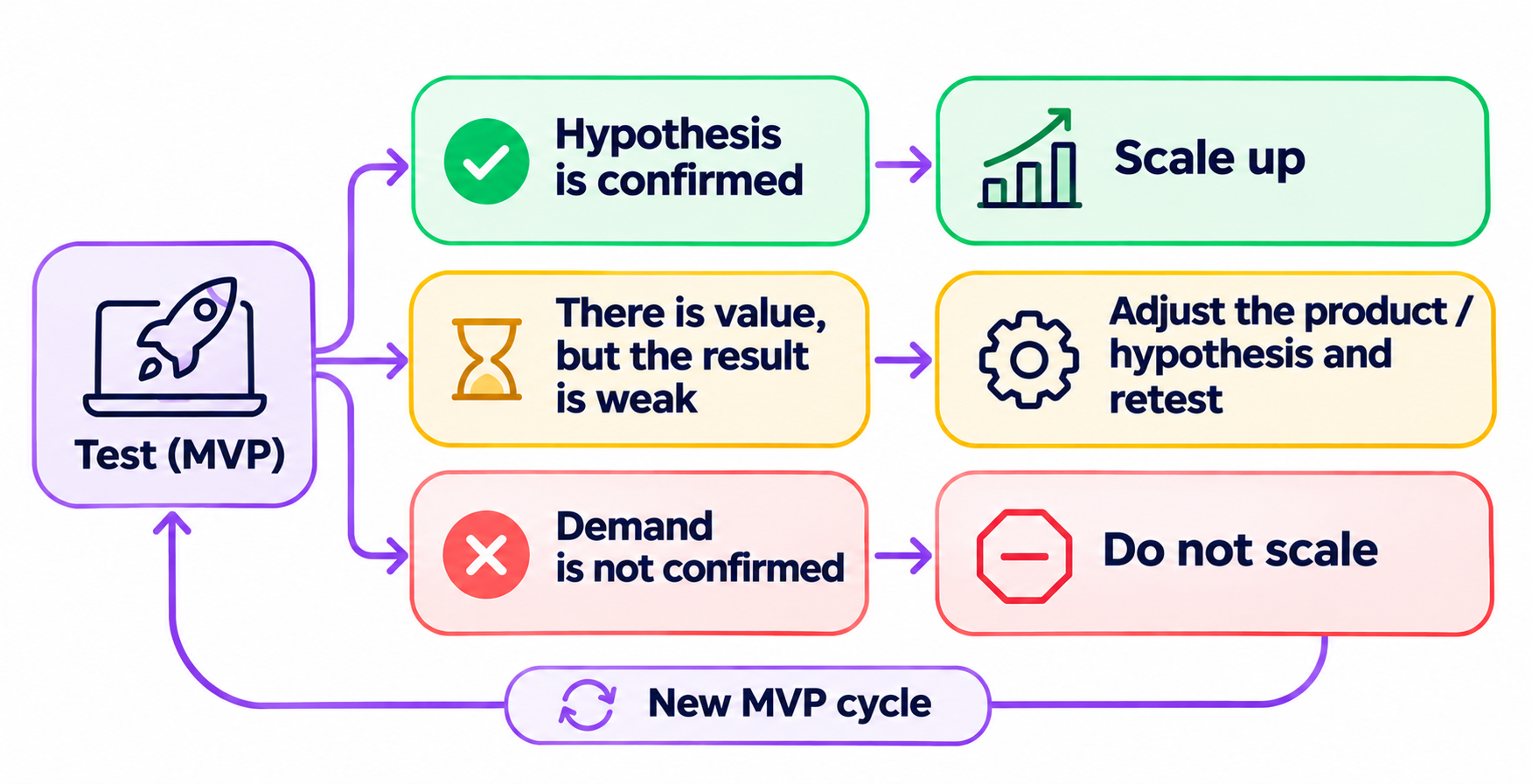
The next iteration then begins.
If the core value proposition has been validated, the team can automate manual processes, improve the interface, and introduce additional features.
If users find the product valuable but are unwilling to pay, the monetization model needs to be tested.
If registrations are high but repeat usage is almost nonexistent, the team should investigate retention and the core user journey.
If there is no demand, adding more features usually will not solve the underlying problem.
Frequently Asked Questions
What Does MVP Mean?
MVP stands for Minimum Viable Product. It is a minimal functional version of a solution designed to validate a product hypothesis.
What Is an MVP?
In product development, an MVP is not a person but an approach and a type of product. But be aware that the abbreviation may have different meanings in other contexts.
How Long Does It Take to Build an MVP?
There is no universal timeline. A simple landing page can be prepared in a few days, while the first version of a complex B2B product may take several months.
Can You Build an MVP Without Coding?
Yes. If the hypothesis can be tested through a manually delivered service, a landing page, or existing tools, custom software development may not be necessary at all.
Are MVPs Only for Startups?
No. Established companies also use MVPs when launching new products, features, or services, or when entering new markets.
The core principle of an MVP is simple: validate the riskiest assumption using real-world data before investing more time and money in product development.
Sources
- Eric Ries — Minimum Viable Product: A Guide. The foundational definition of an MVP and the principles of validated learning. View source
- Atlassian — What Is a Minimum Viable Product (MVP)? The definition, goals, and development stages of an MVP, as well as how it differs from a fully developed product. View source
- Google Ads Help — Keyword Planner. Using Keyword Planner to estimate market demand, search volume, and advertising costs. View source
- Tony Hsieh — The Story of Zappos. An article about the early validation of demand for buying shoes online. View source
- TechCrunch — How DropBox Started As A Minimal Viable Product. The story of Dropbox’s early MVP, its demonstration video, and the growth of its beta waitlist from 5,000 to 75,000 people. View source
- Forbes — The Story of Zappos’ Early MVP. How Nick Swinmurn tested demand for online shoe shopping by posting photos of products from physical stores and purchasing the shoes only after receiving customer orders. View source
© PhoenixProject, with full or partial copying of the material, a link to the source is required.
Comments: 0