How to Promote a Website with AI: The Complete Guide to AI SEO in 2026
In 2026, AI SEO is no longer just about generating large volumes of content with AI tools. Instead, it revolves around strategically applying artificial intelligence across SEO research, keyword analysis, content production, technical optimization, and preparing websites for generative search experiences. AI enables SEO professionals to process large datasets faster, identify patterns, build scalable page structures, and automate repetitive tasks. However, strategic decision-making, fact-checking, editorial review, and quality assurance remain the responsibility of experts.
This guide explains how to utilize AI to enhance a website’s search visibility, where artificial intelligence genuinely improves SEO workflows, and which processes should never be fully automated. You’ll also learn how to optimize your website for Google’s AI-powered search features while preserving originality, credibility, and brand identity.
If your goal is to utilize AI effectively and safely for SEO, it’s essential to shift your focus beyond merely generating a large volume of content. Now, a truly successful AI SEO relies on data analysis, search intent, website architecture, semantic optimization, and technical improvements. Artificial intelligence indeed accelerates many SEO processes. But it cannot replace SERP analysis, professional expertise, or a deep understanding of business objectives.
The Role of Artificial Intelligence in Modern SEO
Today, artificial intelligence plays two distinct roles in SEO. First, it serves as a productivity tool for SEO professionals. So, AI helps analyze data, cluster keywords, generate content drafts, and also identify technical issues across websites. Second, it is now an integral part of Google’s search ecosystem. Google’s algorithms increasingly evaluate whether a page satisfies user intent, solves real problems, and demonstrates expertise and trustworthiness.
Google’s generative search features, including AI Overviews and AI Mode, are powered by Retrieval-Augmented Generation (RAG). Instead of relying solely on a language model’s internal knowledge, Google retrieves relevant pages from its search index, analyzes their content, and generates responses with citations to reliable sources. Google may also use query fan-out, which is a technique that runs multiple related search queries simultaneously to gather information from different perspectives before generating a response.
For SEO professionals, this means that a website must remain fully crawlable and indexable while providing genuine value beyond what already exists online. If a page merely rephrases information from the current top ten search results, search engines, as well as generative AI systems, have fewer reasons to treat it as a reliable source. Original research, proprietary company data, practical case studies, expert insights, and information unavailable elsewhere provide significantly stronger signals. Google consistently recommends publishing original, experience-based content rather than rewriting information that is already widely available across the web.
AI SEO Is Not the Same as Mass AI Content Generation
For years, AI-driven SEO was often associated with spam and the automated publication of low-quality content. Modern AI SEO is fundamentally different. Its purpose is not to generate hundreds of articles from a single template. That approach typically results in such issues as repetitive content, weak informational value, and keyword over-optimization.
Instead, AI delivers the greatest value as an analytical and production assistant. It is good for keyword clustering, preparing SEO briefs, identifying content gaps, generating content outlines, analyzing large volumes of information, and automating technical SEO tasks. Final decisions (including data verification, source selection, editorial review, and quality control) should always remain in the hands of an SEO specialist, editor, or subject-matter expert.
Google also warns against publishing large volumes of scaled content that provides little or even zero value to users. As a result, successful AI SEO is driven not by the quantity of content produced but by the quality of the information, a well-structured website, and genuine expertise.
The Evolution of Search: From Keywords to Semantic Entities
You must clearly understand that the era of ranking pages based solely on exact-match keywords is over. With the introduction of technologies such as BERT and other transformer-based language models, search engines have become far better at understanding relationships between words, entities, and user intent. As for an entity, it can be any uniquely identifiable object, concept, person, company, or brand that possesses its own attributes and relationships.
Modern search engines match user intent with the information extracted from indexed pages. As a result, effective content should include more than just target keywords. It should also cover related terminology, definitions, practical examples, and answers to associated questions.
AI models are highly effective at identifying these semantic relationships and helping build comprehensive topical structures. But its is SEO experts who should review the final keyword clusters and entity lists as well. AI lacks an understanding of a company’s business priorities and may incorrectly group together queries with different search intents.
How Google Uses AI to Evaluate Content
Google relies on numerous automated systems and ranking signals to identify content that is useful, trustworthy, and relevant. One of the most important quality frameworks is E-E-A-T, which stands for:
- Experience
- Expertise
- Authoritativeness
- Trustworthiness
E-E-A-T is not a standalone ranking factor or a numerical score that can be improved through a single technical change. Instead, it represents a framework Google uses to evaluate the overall quality and credibility of content.
To strengthen trust signals, articles should clearly identify the author, include publication and update dates, reference verifiable data, cite primary sources, and incorporate practical examples from real-world experience. Brands seeking long-term search visibility should support their content with evidence and genuine expertise rather than relying solely on keyword optimization. Google’s Search Quality Raters also use E-E-A-T principles when evaluating search quality, although their assessments do not directly influence the rankings of individual pages.
Search engines are increasingly aiming to deliver accurate and reliable answers. To make important pages easier for both users and AI systems to interpret, websites should include concise summaries, descriptive headings, tables, bullet lists, clear definitions, and citations from authoritative sources.
A Scientific Approach to GEO: Insights from Princeton Research
One of the earliest studies on Generative Engine Optimization (GEO) comes from researchers at Princeton, Georgia Tech, and the Allen Institute for AI. In their experiments, several optimization techniques boosted the visibility of selected sources in AI responses by up to 40%. Still, you shouldn’t treat these results as a universal guarantee.
The impact of each method varied depending on the topic, and the experiments didn’t show consistent gains in organic visibility, traffic, or conversions across all generative search engines. Recent reviews of GEO research also stress a clear distinction: an AI model retrieving or citing your page doesn’t automatically mean you get organic search visibility. That’s why you should view GEO techniques as hypotheses to test, not guaranteed ranking factors.
The research identified several practical methods for making content easier for language models to understand and reference.
- Statistics Addition – Replace vague claims with measurable statistics and verifiable data. Whenever numerical data is included, cite its original source and specify when the research was published.
- Quotation Addition – Support key statements with brief quotations from recognized experts. Each quote should clearly identify the expert’s name, position, and organization.
- Cite Sources – Reference primary studies, official documentation, and trusted statistical databases instead of relying solely on secondary summaries.
- Fluency Optimization – Improve readability by simplifying complex sentence structures so that both users and AI systems can process the information more efficiently.
These techniques are most effective when we have an article that is already relevant to the search query, contains valuable information, and is fully accessible to search engines. Simply adding statistics or quotations does not guarantee that a page will appear in AI-generated answers.
Five Key Areas Where AI Improves SEO
Successfully integrating AI into an SEO strategy is always about a systematic approach. Simply deploying an AI chatbot will not produce dramatic improvements in organic traffic. Artificial intelligence provides the greatest value in five core areas: semantic research and keyword clustering, content creation and optimization, technical SEO, user experience, and personalization and generative search optimization.
Each area addresses a specific set of challenges and helps SEO professionals process large volumes of information far more efficiently. But before implementing any AI-generated recommendations, SEO specialists should always validate the data, keyword targets, business objectives, and the overall condition of the website.
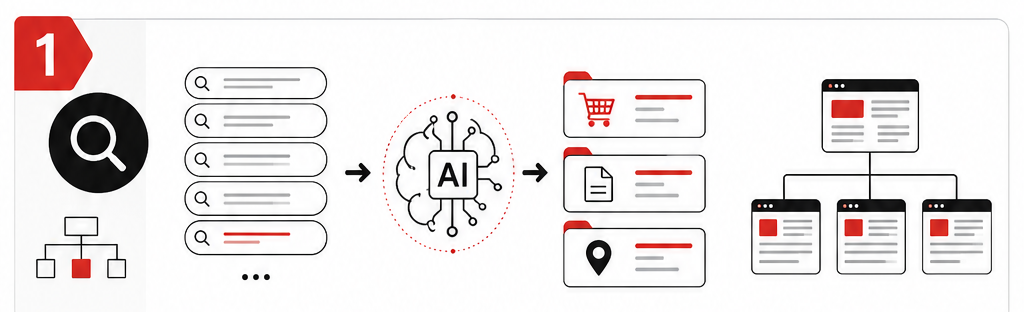
1. Semantic Research and Keyword Clustering
Building a semantic keyword database manually for a large e-commerce website or content portal can take weeks. But AI accelerates this process dramatically. Modern language models can group search queries by semantic similarity, identify related keyword variations, and generate preliminary keyword clusters.
AI can also distinguish between commercial search queries, informational queries, and navigational queries.
Based on these classifications, it can propose an initial website architecture that aligns landing pages with different search intents. This helps create pages that answer users’ actual questions rather than simply targeting isolated keywords.
However, you should never allow AI to make the final clustering decisions on its own. SEO professionals must still evaluate Google’s actual search results, the commercial value of each keyword group, landing page architecture, and search intent consistency. Some seemingly similar keywords require separate landing pages, while multiple clusters may be better consolidated into a single comprehensive article.
You can measure the effectiveness of semantic clustering through successful page indexation, improved rankings across target keyword groups, the absence of keyword cannibalization, and organic conversions.
2. Content Creation and Optimization: Finding the Right Balance Between AI and Human Expertise
AI-assisted content creation should follow the Human-in-the-Loop principle. AI can assist with generating first drafts, creating article outlines, suggesting headlines, and identifying potential reference sources. But it is a copywriter, SEO specialist, or subject-matter expert who should perform final editing.
AI is also highly effective at optimizing Title tags, Meta Descriptions, H1-H4 headings, FAQ sections, and concise answers to frequently asked questions. For large websites, this significantly speeds up optimization across thousands of pages while helping identify weak or incomplete content.
You should still review every AI-generated article for factual accuracy, consistency with the brand’s tone of voice, genuine informational value, and natural keyword placement. Expert commentary, real-world case studies, and proprietary company data make content considerably more valuable and clearly distinguish it from generic AI-generated material.

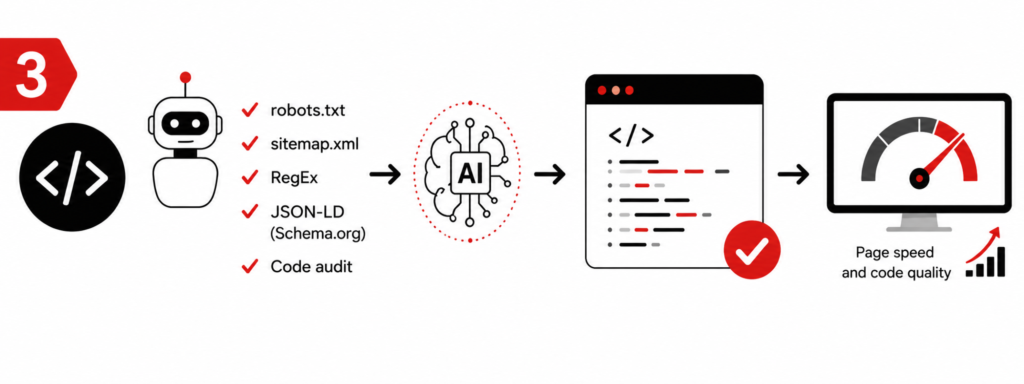
3. Technical SEO: Automating Audits and Code Generation
Currently, technical SEO remains the foundation of sustainable organic growth. Modern language models can accelerate many technical workflows by generating code and preparing implementation drafts. There are some common use cases to consider:
- generating robots.txt directives and XML sitemaps;
- writing regular expressions (RegEx) for redirects and analytics filters;
- generating Schema.org JSON-LD structured data;
- identifying potential HTML and CSS issues;
- creating scripts for processing URLs, metadata, keyword lists, and audit results.
AI significantly speeds up development tasks and helps identify potential problems. But it does not eliminate the need for expert review. An SEO specialist or developer should validate every technical implementation before deployment.
Structured data must accurately reflect the visible content of a page and comply with the requirements of the selected Schema.org type. Also note that Google does not require any special structured data specifically for AI Overviews or AI Mode.
4. Personalization, User Experience, and Conversion Optimization
AI-powered systems can analyze user behavior and dynamically adapt website experiences to individual visitors. For example, these are recommendation engines that suggest products based on previous browsing behavior. AI-powered chatbots help users find relevant products, services, or information more quickly.
Website usability, page speed, and overall interaction quality all contribute to user satisfaction, conversion rates, and the effectiveness of organic traffic. The success of personalization initiatives should be evaluated using business metrics such as completed conversions, engagement depth, returning visitors, and revenue.
At the same time, you should not attribute ranking improvements solely to longer session durations or lower bounce rates. Google evaluates hundreds of ranking signals simultaneously, and the impact of individual behavioral metrics cannot be reduced to a single universal formula.

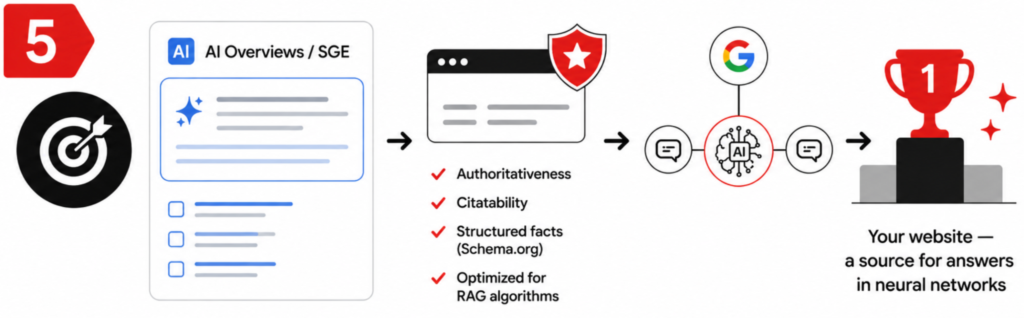
5. Optimizing for AI Overviews, AI Mode, and GEO
In 2026, optimizing websites for generative AI has become an essential part of modern SEO. Users increasingly receive AI-generated answers through Google’s AI Overviews and AI Mode. However, Google continues to treat visibility in these features as an extension of traditional SEO rather than a separate optimization discipline.
Generative Engine Optimization (GEO) refers to optimizing content for AI-powered search engines and generative search experiences. This means that GEO focuses on making it easier for AI models to discover, understand, and reference trustworthy information from your website when generating responses.
Note that the term GEO is sometimes used to describe geographic SEO. But in this article, GEO refers exclusively to Generative Engine Optimization. Local SEO remains a separate discipline with a focus on regional landing pages, business profiles, structured business information, and consistent NAP (Name, Address, Phone Number) data.
To increase the likelihood of being referenced in AI-generated responses, your content should include clear and accurate definitions, concise summaries, original research and proprietary data, authoritative sources, and direct answers to real user questions. At the same time, pages must remain crawlable, indexed, and eligible to appear in Google’s traditional search results.
You should understand that optimizing for AI does not guarantee inclusion in AI-generated responses. Even when a website meets every technical requirement, Google independently decides which sources to reference for each query. The search engine explicitly states that complying with its technical guidelines does not guarantee crawling, indexing, or ranking. The objective of an SEO professional is therefore to maximize the probability of being cited, not to promise guaranteed visibility.
Brand reputation is also very important. Customer reviews, comparison articles, editorial mentions, and independent publications all contribute to the broader information ecosystem surrounding a brand. So, companies should actively monitor these mentions, verify inaccurate information, and respond to legitimate criticism. But keep in mind that negative reviews do not automatically prevent a brand from appearing in AI-generated responses, just as removing negative mentions does not guarantee visibility.
How to Use AI in SEO Without Sacrificing Quality
| SEO Task | What AI Can Do | What Should Be Reviewed by an SEO Specialist |
| Keyword Research | Cluster keywords, identify related search intent, and suggest topical structures | Validate Google SERPs, evaluate commercial intent, and review landing page strategy |
| Content Creation | Generate outlines, headlines, FAQs, summaries, and metadata | Verify facts, maintain brand voice, ensure originality, and provide additional value |
| Technical SEO | Generate scripts, RegEx rules, Schema.org markup, and templates | Review code quality, deployment safety, and indexing impact |
| Competitor Analysis | Compare website structures and identify content gaps | Determine which competitor strategies genuinely contribute to rankings |
| GEO & AI Search | Generate definitions, structured answers, tables, and summaries | Verify factual accuracy, evaluate sources, and eliminate misleading claims |
A Step-by-Step Framework for Implementing AI in Your SEO Strategy
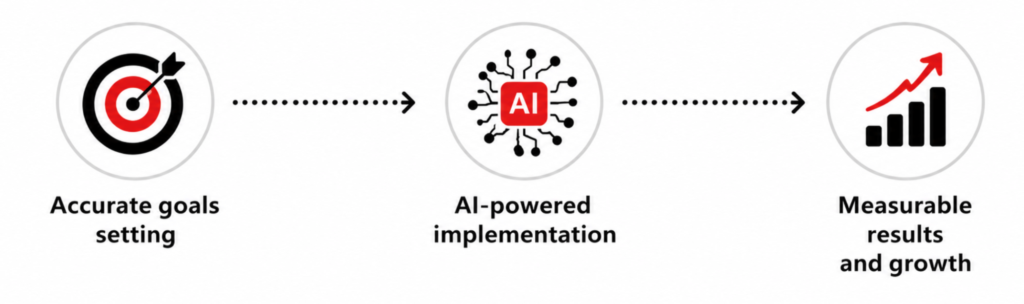
Successfully integrating AI into SEO requires a structured approach. Breaking implementation into clearly defined stages helps control costs, validate hypotheses, and measure performance throughout the process.
Step 1. Research Your Industry and Competitors
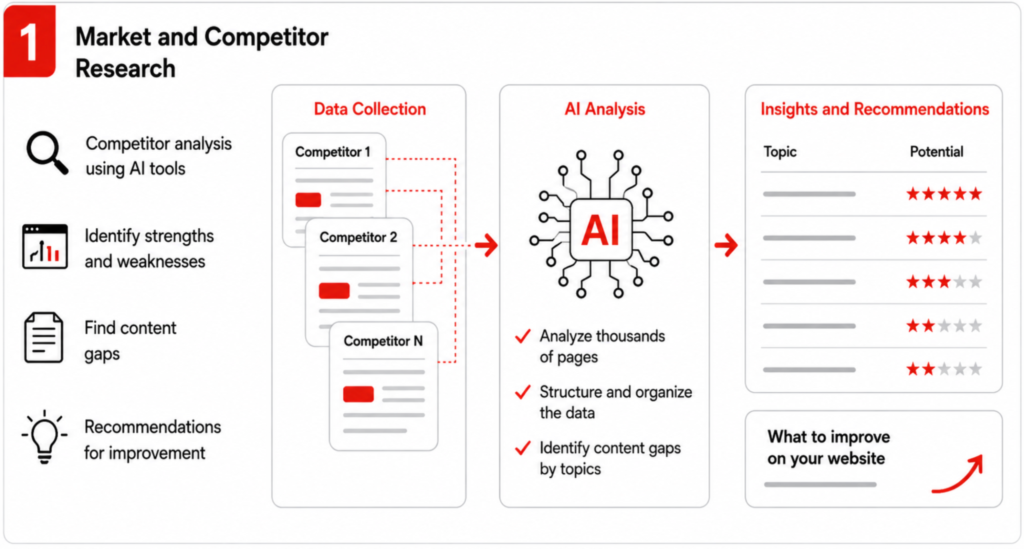
You should always start by analyzing your competitive landscape. AI tools can quickly process competitor websites, compare their structures, and identify content gaps. Large language models are capable of analyzing thousands of pages and highlighting topics where competitors provide limited or incomplete information.
Based on these findings, SEO specialists determine three important things:
- topics that generate demand;
- keywords with commercial potential;
- content formats performing best in Google.
AI significantly accelerates research, but strategic conclusions should always rely on actual search results, website analytics, and business goals.
Step 2. Build a Content Plan Based on Search Intent
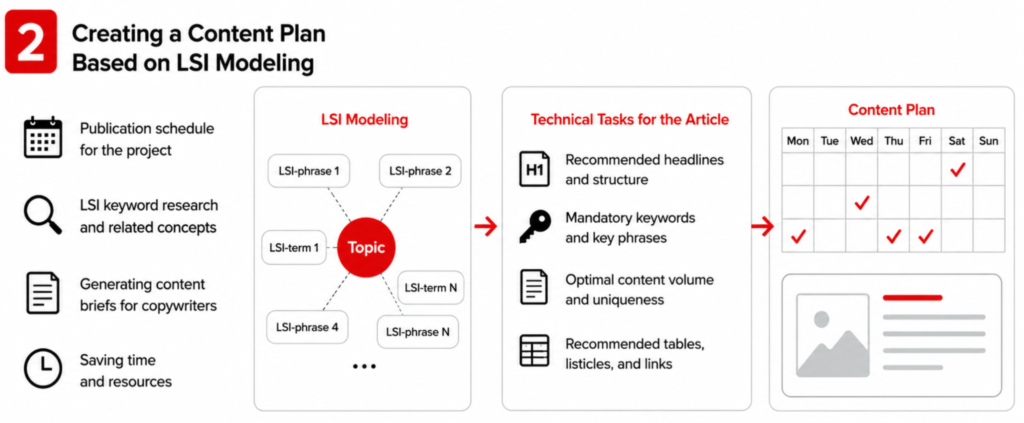
Once you define a website structure, AI can assist in building a scalable content plan and preparing SEO briefs.
For every future article, AI can generate the following:
- suggested headlines;
- article outlines;
- related keywords and semantic entities;
- questions users expect to be answered;
- recommended sources that require verification;
- ideas for tables, illustrations, lists, and other visual elements.
This approach helps every article satisfy search intent more comprehensively while reducing the time required to prepare detailed content briefs.
Bге иefore publishing, SEO professionals should still review:
- Google’s search results;
- keyword priorities;
- alignment with business objectives.
Step 3. Content Distribution and Link Building with AI Assistants
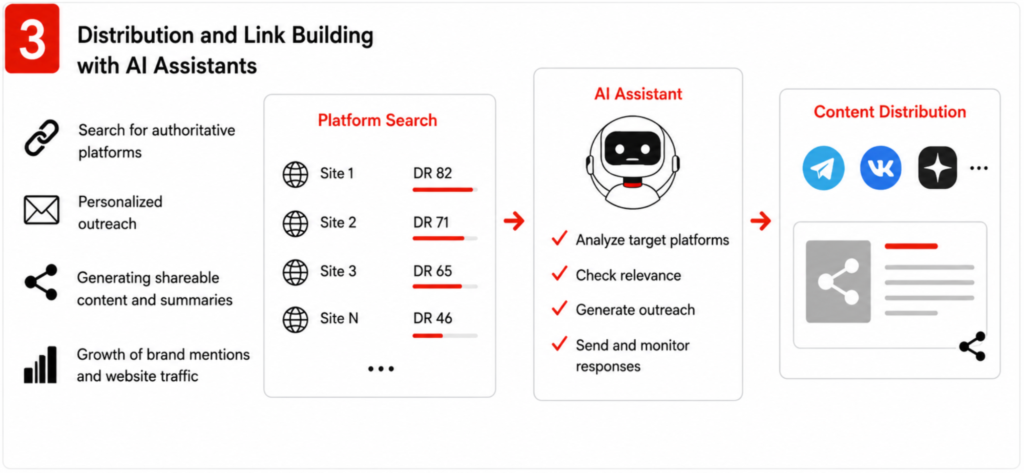
Creating high-quality content is only half the job. It also needs effective distribution. AI assistants can help identify relevant websites, perform initial prospect qualification, and draft personalized outreach emails.
AI can also generate multiple versions of promotional content for social media, Telegram channels, blogs, and newsletters. However, outreach targets, publication requirements, backlink quality, and final messaging should always be reviewed by a human specialist.
Link building delivers the best results when integrated into an overall SEO strategy. High-quality backlinks help search engines discover new pages, strengthen brand authority, and also generate valuable referral traffic.
AI Tools for SEO Professionals
Every SEO specialist needs a reliable toolkit, with the rhe right combination depending on data volume, project complexity, content requirements, and available budget.
| Tool | Primary Use Cases | Approximate Monthly Price |
| ChatGPT | Content outlines, data analysis, code generation, and prompt engineering | Plus – $20 (Free plan available) |
| Claude | Long-document analysis, writing, and technical documentation | Pro – $20 (Free plan available) |
| Perplexity | Research with citations, competitor analysis, and fact-finding | Pro – from $17/month (annual billing) |
| Gemini | Content generation, data analysis, and Google Workspace integration | Google AI Pro – approximately $19.99/month |
Pricing and subscription availability vary by country and billing method. Before publishing or updating any article, you should always verify current pricing directly on the providers’ official websites. As of July 2026, ChatGPT Plus and Claude Pro both cost $20 per month in the United States, while Google AI Pro is priced at $19.99 per month. Keep in mind that Perplexity’s pricing varies depending on the selected billing cycle.
Rather than relying on a single platform, SEO professionals often combine multiple AI tools. One may excel at long-form writing, another at source discovery, and the third at code generation. Organizations can also integrate AI directly into internal workflows through APIs, although API pricing is separate from standard user subscriptions.
Security and Risks: How to Avoid Search Penalties for AI-Generated Content
Utilizing generative AI in SEO brings significant advantages, but it may also cause some risks. Google actively discourages low-value, mass-produced content created without adding meaningful value for users. So, publishing hundreds of nearly identical AI-generated articles without proper review can result in a loss of search visibility.
Before publishing AI-assisted content, use the following checklist.
- Fact-checking. AI models can generate inaccurate statistics, laws, quotations, and even references. But you should always verify information against primary sources and record the date when the data was last validated.
- Value for the reader. Evaluate whether your article answers the user’s question better than the current top-ranking competitors. Strengthen it with your company’s expertise, original examples, and insights that cannot be found elsewhere.
- Originality. Support your content with real case studies, original photography, expert commentary, and proprietary research.
- Formatting and structure. Organize the content with clear headings, bullet points, tables, and concise answers to improve readability.
- Avoid over-optimization. You should incorporate keywords naturally. Google specifically warns that excessive keyword repetition and artificially increasing page length without adding value for users may be considered over-optimization.
- Review technical changes. Never deploy AI-generated code without testing and reviewing it with a developer.
- Source verification. Make sure all links point to up-to-date information and that quotations accurately reflect the original sources.
| The primary goal of SEO is to help users find reliable, high-quality answers, not to manipulate search algorithms. Adhering to established quality standards reduces risk and provides a solid foundation for sustainable long-term organic traffic growth. |
Common Mistakes When Implementing AI in SEO
- publishing AI-generated articles without editorial or expert review;
- copying the structure of the current top-ranking pages without adding unique value;
- using a single prompt for every type of page;
- publishing statistics, research findings, and quotations without verifying the original sources;
- implementing AI-generated technical changes without developer oversight;
- accepting AI-generated keyword clusters without analyzing Google’s search results;
- confusing Generative Engine Optimization (GEO) with geographic SEO;
- creating separate pages for every variation of similar search queries;
- treating AI SEO as a standalone “magic solution” instead of integrating it into a comprehensive SEO strategy.
Which Metrics Should You Track After Implementing AI SEO?
The success of AI SEO should never be measured solely by the number of articles generated or workflows automated. The real question is whether AI improves your website’s visibility, content quality, traffic, and business performance at all.
There are key metrics to consider:
- indexation of new and updated pages;
- visibility growth across priority keyword clusters;
- Google rankings;
- impressions, clicks, and click-through rate (CTR);
- organic traffic and conversions;
- the percentage of pages receiving impressions but no clicks;
- user engagement and interaction quality;
- the number of AI-generated articles requiring substantial manual revision;
- brand mentions and citations in AI-generated responses;
- visibility within AI Overviews, AI Mode, and other generative search features.
For Google Search, generative visibility can now be monitored through dedicated reports in Google Search Console, which provide performance data for AI Overviews, AI Mode, and other AI-powered search experiences.
The Future of Search: New Challenges for SEO Professionals
Search continues to evolve. Users increasingly receive concise AI-generated answers directly within search results. At the same time, traditional search and website visits are not disappearing. Instead, generative search has become another touchpoint connecting users, brands, and online content.
For SEO professionals, this means expanding the set of KPIs used to measure success. Traditional SEO metrics are now complemented by indicators such as brand mentions, citation frequency, visibility in AI-generated responses, and traffic quality from generative search. Practice shows that organizations that adapt their websites to these emerging search experiences are more likely to maintain and grow their visibility over time.
In the AI era, the role of an SEO specialist is to ensure that websites remain technically accessible, publish genuinely valuable content, support every claim with credible sources, and continuously monitor performance across both traditional search results and generative search experiences.
Bottom Line
So, successfully using AI for SEO in 2026 is not about replacing SEO professionals with artificial intelligence. Based on our experience, the most effective strategy combines automation with human expertise. AI helps analyze search queries, process large datasets, generate content, and assist with technical implementation, while experienced specialists validate information, review sources, maintain quality standards, and evaluate business impact.
AI SEO works best when it is a part of a comprehensive search optimization strategy. A technically sound website, valuable content, strong brand authority, trustworthy sources, and continuous performance analysis significantly increase the likelihood of achieving sustainable visibility in both traditional Google Search and generative search experiences.
© PhoenixProject, with full or partial copying of the material, a link to the source is required.
Comments: 0