How Boosting Volume Affects Backlink Indexing: Results of a Phoenix Project Experiment
Placing a backlink doesn’t automatically mean you’ll benefit from it.
We’ve already covered the role of link building in an overall SEO strategy in a separate article. Here we’ll focus on the next stage: getting the pages that host your links indexed.
First, Google has to discover the page, crawl it and decide whether to index it. And indexing isn’t guaranteed: as the official Google Search Central documentation notes, a page can remain outside the index even after the search engine has processed it.
Some pages carrying crowd links and submissions can stay unindexed for a long time.
This raises a logical question: can additional boosting speed up the process, and does it make sense to keep increasing the boosting volume?
To answer this without guesswork, we ran an internal Phoenix Project experiment.
We compared four boosting volumes — from standard to six times the standard (x6) — separately for crowd links and submissions. We tracked indexing over three monthly checks.
The short answer: a higher boosting volume can improve indexing, but the relationship is far from linear.
At the third check, 62.7% of crowd links were indexed in the standard boosting group and 67.2% in the x2 group. At six times the volume (x6), the figure was 67.5% — only 0.3 percentage points above x2.
Submissions behaved differently: the indexing rate rose with each increase in boosting volume, reaching 56.0% at x6.
Let’s look at what these results tell us and at what point extra boosting stops delivering a noticeable gain.
How we ran the experiment
The experiment ran from July to September 2026. We tested two types of external placements:
- Crowd links — links from topical discussions, forums and comments.
- Submissions — links from directories, profiles and other platforms where project information can be published.
After placing the crowd links and submissions, we additionally boosted the pages where they were published. The goal of this boosting is to help search bots discover the pages and increase the likelihood of indexing.
We tested four boosting volumes:
- standard boosting (x1) — the usual volume we use in our work;
- x2 — double the standard boosting volume;
- x4 — four times the standard volume;
- x6 — six times the standard volume.
In other words, we compared results as the boosting volume increased step by step relative to the standard option.
For each option, we created a separate group of 1,000 links. In total, the experiment included 8 groups — 8,000 links.
The placements came from different projects. Links were not strictly randomized across groups, and the GEO of the platforms was not taken into account when forming the samples.
We tracked indexing with the Linkbox service over three consecutive monthly checks.
When checking indexing, it’s important to distinguish between third-party monitoring services and Google Search Console. Search Console lets you track the indexing status of your own site’s pages, but it doesn’t give the same access to data for arbitrary third-party sites.
We didn’t submit pages for indexing separately. This allowed us to track results without third-party tools for sending URLs to search engines.
It’s important to keep the statistical margin of error in mind. Each boosting level used a separate sample of 1,000 links. Assuming the observations are independent, the margin of error for an individual figure is about ±3 percentage points at a 95% confidence level.
When comparing two groups, the uncertainty is higher — roughly ±4–4.4 percentage points. So small differences, for example between 66.7% and 67.2%, can’t be read as proof that one option is better.
In addition, since the groups weren’t formed through strict randomization, the observed differences can’t be attributed solely to the change in boosting volume.
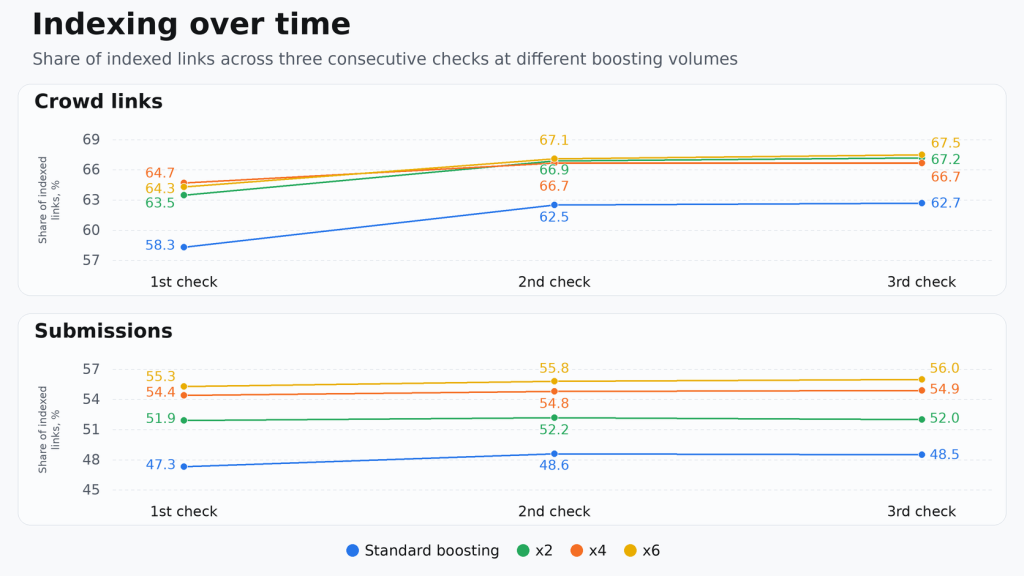
Indexing of crowd links and submissions across three consecutive checks at different boosting volumes.
Results: how indexing changed over three checks
We compared the share of indexed links at each of the three checks. Results for all eight groups are shown in the table below.
| Boosting volume | Crowd, 1st check | Crowd, 2nd check | Crowd, 3rd check | Submissions, 1st check | Submissions, 2nd check | Submissions, 3rd check |
|---|---|---|---|---|---|---|
| Standard | 58.3% | 62.5% | 62.7% | 47.3% | 48.6% | 48.5% |
| x2 | 63.5% | 66.9% | 67.2% | 51.9% | 52.2% | 52.0% |
| x4 | 64.7% | 66.7% | 66.7% | 54.4% | 54.8% | 54.9% |
| x6 | 64.3% | 67.1% | 67.5% | 55.3% | 55.8% | 56.0% |
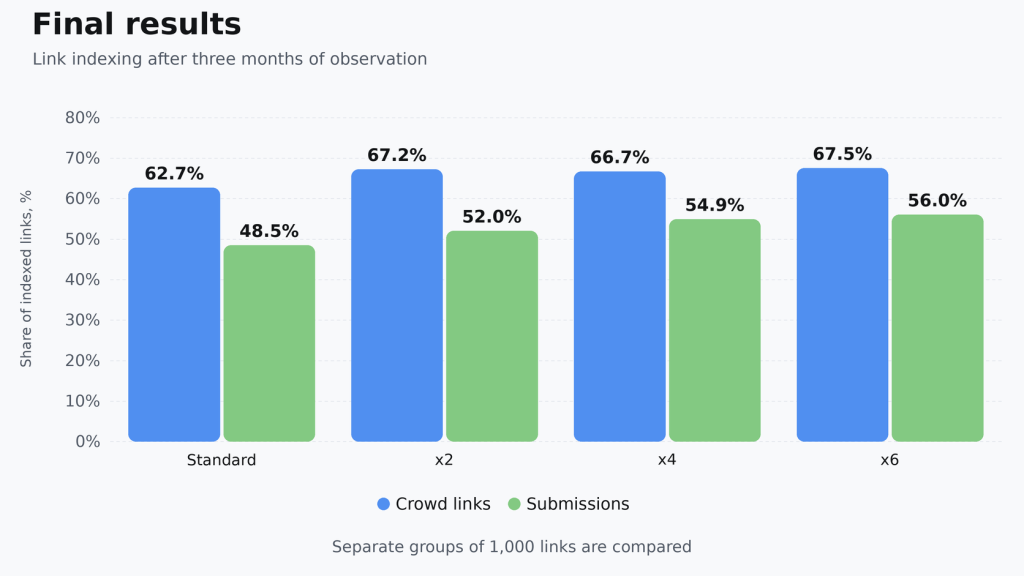
Share of indexed links at the third check: crowd — 62.7–67.5%, submissions — 48.5–56.0%
At the third check, every group with increased boosting showed a higher share of indexed links than the standard option.
For crowd links, the difference ranged from 4 to 4.8 percentage points; for submissions, from 3.5 to 7.5 percentage points.
That said, not all differences were statistically significant. In a rough comparison of independent samples, the most convincing differences from the standard option were seen for crowd links at x2 and x6, and for submissions at x4 and x6.
So the results point to a positive relationship between boosting volume and indexing, but they don’t support the claim that any increase in volume will necessarily deliver an additional effect.
What’s more interesting, though, is not just the final percentages but how the return changes as volume keeps increasing.
Crowd links: most of the gain comes at x2
In the crowd link group with standard boosting, the indexing rate at the third check was 62.7%. With double the boosting volume (x2), it reached 67.2% — 4.5 percentage points higher.
Further increases in volume didn’t bring a comparable gain:
- x4 — 66.7%;
- x6 — 67.5%.
So when moving from x2 to x6, the boosting volume tripled, while the observed difference in indexing was just 0.3 percentage points.
This difference is within the margin of error and does not confirm that six-fold boosting outperforms double boosting.
Practical takeaway: under the conditions of our experiment, x2 delivered results comparable to the more intensive options. So any further increase in volume should be weighed against the additional cost, not pursued just to maximize the indexing rate.
Submissions: indexing grows as boosting volume increases
Submissions showed a different pattern. Unlike crowd links, the share of indexed placements rose consistently with each boosting level.
By the third check, the results were:
- Standard boosting — 48.5%.
- x2 — 52.0%.
- x4 — 54.9%.
- x6 — 56.0%.
So with six-fold boosting, the rate was 7.5 percentage points higher than with the standard option.
At the same time, the additional gain between adjacent levels gradually shrank:
- Standard to x2 — +3.5 pp.
- x2 to x4 — +2.9 pp.
- x4 to x6 — +1.1 pp.
However, the differences between individual adjacent levels are within the margin of error. So the diminishing return should, for now, be seen as an observed trend rather than a proven pattern.
From a practical standpoint, the question is: does the gain justify the extra cost?
Without exact cost data for each boosting level, it’s impossible to say definitively which option is economically optimal. More intensive boosting may be justified for some projects, but the decision shouldn’t be based on the maximum indexing rate alone.
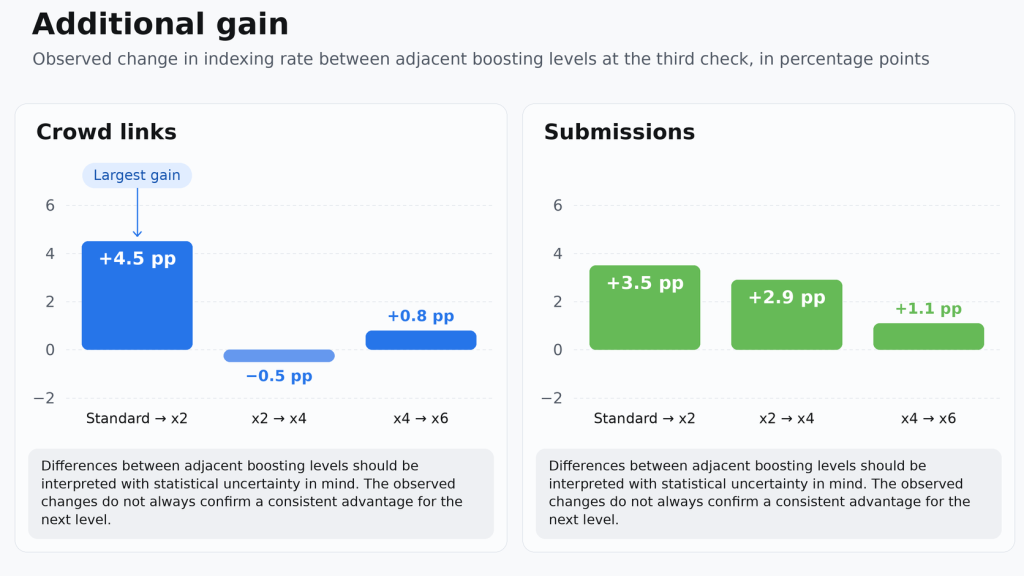
Observed change in indexing rate between adjacent boosting levels at the third check, in percentage points.
How quickly links get indexed
Another interesting finding is how indexing developed over time.
The most noticeable changes happened between the first and second checks. By the third check, the figures had practically leveled off.
Between the second and third checks, the changes were:
- Crowd links — from 0 to +0.4 percentage points.
- Submissions — from −0.2 to +0.2 percentage points.
This means that, under the conditions of our experiment, most of the indexing dynamics had already played out by the second check.
At the same time, groups with increased boosting showed higher rates from the very start of observation.
For example, crowd links with x2 boosting reached 63.5% indexing at the first check. That’s comparable to the standard option’s result at the third check — 62.7%.
At the first check, the difference between standard boosting and x2 was 5.2 percentage points.
Practical takeaway: the results suggest that additional boosting may be associated not only with a higher final indexing rate, but also with faster indexing.
However, confirming this effect requires further research with stricter assignment of links to groups.
Crowd links indexed better than submissions at every boosting volume
Another result of the experiment concerns the difference between the two placement types.
In every group studied, crowd links showed a higher indexing rate than submissions at a comparable boosting volume.
At the third check, the difference was:
- Standard boosting — 14.2 pp.
- x2 — 15.2 pp.
- x4 — 11.8 pp.
- x6 — 11.5 pp.
Even at the highest volume tested, submissions didn’t reach the rate of standard crowd links: 56.0% vs. 62.7%.
That doesn’t mean submissions are less useful for every link building strategy. Different placement formats serve different purposes, and indexing results can be influenced by platform characteristics and other factors.
Practical takeaway: in our experiment, crowd links were indexed more often than submissions at all four boosting levels. But it would be premature to apply this pattern to every project without further testing.
Which boosting volume to choose
The results show that maximum boosting volume doesn’t always deliver a noticeable advantage. When choosing an approach, consider the link type, indexing dynamics and additional costs.
Based on the data, we can draw four practical recommendations.
- For crowd links, treat x2 as a starting point
With double the boosting volume, the indexing rate was 4.5 percentage points higher than with the standard option. Increasing it further to x4 and x6 showed no convincing additional advantage.
- For submissions, factor in the cost of boosting
The highest rates relative to the standard option were seen at x4 and x6: +6.4 and +7.5 percentage points respectively.
However, without a cost calculation it’s impossible to tell how economically justified a further increase in volume is.
- Assess indexing dynamics after the second check
In our experiment, the figures changed only slightly between the second and third checks. This means the second check can be used for a preliminary assessment, while still continuing to monitor.
- Placement type matters
Crowd links showed a higher indexing rate than submissions at every boosting level tested.
That said, the choice of format should depend not only on indexing but also on the goals of the specific project.
Key principle: increase boosting volume not to hit the highest possible rate, but based on how much additional value it can deliver relative to its cost.
How we apply these results in our work
For Phoenix Project, this experiment is a way to evaluate link boosting approaches more accurately and make decisions based on actual metrics.
When planning link building, it’s important to consider not only the number of placements, but also their indexing, the type of platforms and the cost of additional actions.
For example, for crowd links, the test results support treating double boosting as a reasonable starting point. For submissions, a decision to increase volume further requires a separate assessment of effectiveness and cost.
This approach helps avoid mechanically building up link mass and lets us choose the scope of work based on the goals of each project.
Learn more about how we approach link building in the Link Building by Phoenix Project section.
How the results compare with other studies
Some public studies on backlink indexing focus on comparing individual services and methods of submitting pages for indexing.
For example, Matthew Woodward tested 14 indexing methods on a sample of 200 pages. After 14 days, only three methods got pages into Google’s index.
Our experiment addresses a different question: we didn’t compare indexing services, but studied how the figures change as the volume of backlink boosting increases.
The results of these studies can’t be compared directly, but they show the importance of testing different indexing approaches experimentally.
Limitations of the experiment
The results let us assess the relationship between boosting volume and backlink indexing. However, several limitations should be kept in mind when interpreting them.
First, the experiment used links from different projects. Links weren’t strictly randomized across groups, and the GEO of the placements wasn’t controlled. So the differences in results may have been influenced not only by boosting volume but also by the characteristics of the platforms themselves.
Second, each boosting level used a separate group of 1,000 links. As noted above, small differences between figures may fall within the margin of error.
Third, indexing was tracked with Linkbox. Pages were not submitted for indexing separately.
Finally, this is a single experiment. Confirming how stable these trends are will require repeat tests with stricter assignment of links to groups.
Key takeaway: a higher boosting volume was accompanied by a higher indexing rate, but further increases in volume didn’t always bring a comparable gain.
That’s why, when planning link building, it’s important to evaluate not just the number of placements and the boosting volume, but also the results achieved, the additional costs and the specifics of each project.
This approach lets you treat link work as part of comprehensive SEO, where decisions are based on measurable results rather than just the volume of work done.
Sources
- Google Search Central. In-depth guide to how Google Search works. Official documentation on crawling and indexing pages.
- Google Search Console Help. Page indexing report. Official help on checking page indexing status.
- Penn State University. Inference for Two Samples. Materials on statistically comparing two independent proportions.
- Matthew Woodward. Backlink Indexing Case Study: Testing 14 Different Indexing Methods. An experimental comparison of indexing methods.
Yevhen Sarhosh is the founder of Phoenix Project. He has worked in SEO for over 15 years and has specialized in link building for over 10 years.
He has personally led and supervised more than 2,000 projects across 27 niches for companies in Tier-1 and Tier-2 countries. His areas of expertise include link building, multi-tier link building and SEO strategy development.
Yevhen runs the SEOETC Telegram channel, where he shares his experience, practical observations and experiment results.
© PhoenixProject, with full or partial copying of the material, a link to the source is required.
Comments: 0